


Author:
Luca Bonura

What are the best marketing analytics tools for small businesses?
21 Jan 2026
|
14
min read

What are the best marketing analytics tools for small businesses?
21 Jan 2026
Dec 13, 2025
14
Dec 13, 2025

"For most UK small businesses, the best marketing analytics tools are Google Analytics 4 for its free, in-depth website data, and Adlarion for its ability to centralise data from multiple channels and translate it into plain-English, actionable insights. For those seeking a privacy-focused alternative, Matomo offers a powerful self-hosted or cloud solution."
~ Luca Bonura
Does it feel like you're flying blind with your marketing? You're not alone. Many UK entrepreneurs know that data is crucial, but the world of marketing analytics often feels like it was built for large corporations with dedicated data teams. The good news is that you don't need a degree in data science or a massive budget to make smarter, data-driven decisions. With the right tools and a simple routine, you can stop guessing and start growing your business, whether you're running a local shop in Manchester or a plumbing business in Leeds.
This guide is designed for busy UK business owners who want to understand what's working, what isn't, and where to invest their hard-earned money for the best results. We'll cut through the jargon and give you a practical, actionable plan.
Here's what you'll learn:
A clear comparison of the top marketing analytics tools for UK small businesses.
The four essential metrics that directly impact your bottom line.
A 14-day plan to get your analytics set up from scratch.
A simple 15-minute weekly routine to stay on top of your data without the overwhelm.
How to avoid common pitfalls like "analysis paralysis" and focusing on vanity metrics.
What is Marketing Analytics? (And What It Isn't)
In simple terms, marketing analytics is the process of measuring, managing, and analysing your marketing performance to maximise your return on investment (ROI). For a small business, this doesn't mean drowning in spreadsheets or complex algorithms. It's about answering 4 fundamental questions:
Where are my customers coming from?
Which marketing channels are bringing in the most valuable leads?
How much does it cost to acquire a new customer?
Are my advertising campaigns actually making money?
It's crucial to distinguish between metrics and analytics. Metrics are the raw numbers (e.g., 1,000 website visitors, 50 new followers). Analytics is the practice of using those numbers to make strategic decisions (e.g., "We got 1,000 visitors from our Facebook ad, but none of them made a purchase, so we need to change the ad's message").
Why You Can't Afford to Ignore Your Data
In today's competitive market, especially with tight margins in the UK economy, relying on gut feelings is a risky strategy. Embracing data helps you move from hoping for results to engineering them.
Budget Efficiency: Stop wasting money on campaigns that don't convert. Analytics shows you exactly where your budget is having the most impact, allowing you to double down on what works and cut what doesn't.
Deeper Customer Insight: Understand who your best customers are, where they spend their time online, and what messages resonate with them. This allows you to create more effective and personalised marketing campaigns.
Competitive Advantage: While your competitors are guessing, you'll be making informed decisions based on real-world performance data, allowing you to adapt and pivot much faster.
The Best Marketing Analytics Tools for UK Small Businesses: A Comparison
Choosing the right tool depends on your budget, technical comfort level, and how much time you can dedicate to analysis. Here's a breakdown of the best options for UK small businesses.
Tool | Best for | Cost (from) | Effort | UK Notes |
|---|---|---|---|---|
In-depth website analysis | Free | High | Industry standard, but can be complex to ensure UK-GDPR compliance. | |
Automated insights & action | £149/month | Low | Designed for UK SMBs; translates data into plain English. | |
Businesses in the Zoho ecosystem | \~£20/month | Medium | Good value if you already use other Zoho products. | |
Privacy-conscious businesses | Free (self-hosted) or \~£17/month (cloud) | High (self-hosted) / Medium (cloud) | Excellent for UK-GDPR compliance as you own the data. | |
All-in-one marketing & CRM | \~£15/month | Medium | Powerful, but can be overkill if you only need analytics. |
The Free Powerhouse: Google Analytics 4 (GA4)
Why it's great: GA4 is the industry standard for a reason. It provides incredibly detailed information about who is visiting your website, how they found you, and what they do once they're there. When paired with Looker Studio (formerly Google Data Studio), you can create powerful, shareable dashboards to visualise your data.
The Harsh Truth for SMBs: While "free" is tempting, GA4 is a trojan horse of complexity. For a local bakery owner, spending 5 hours a week wrestling with GA4 to manually import cost data from Facebook Ads is not free - it's a hidden cost of hundreds of pounds in lost time. It's a professional tool for professional analysts, not for a business owner who needs quick answers.
The Marketing Translator: Adlarion
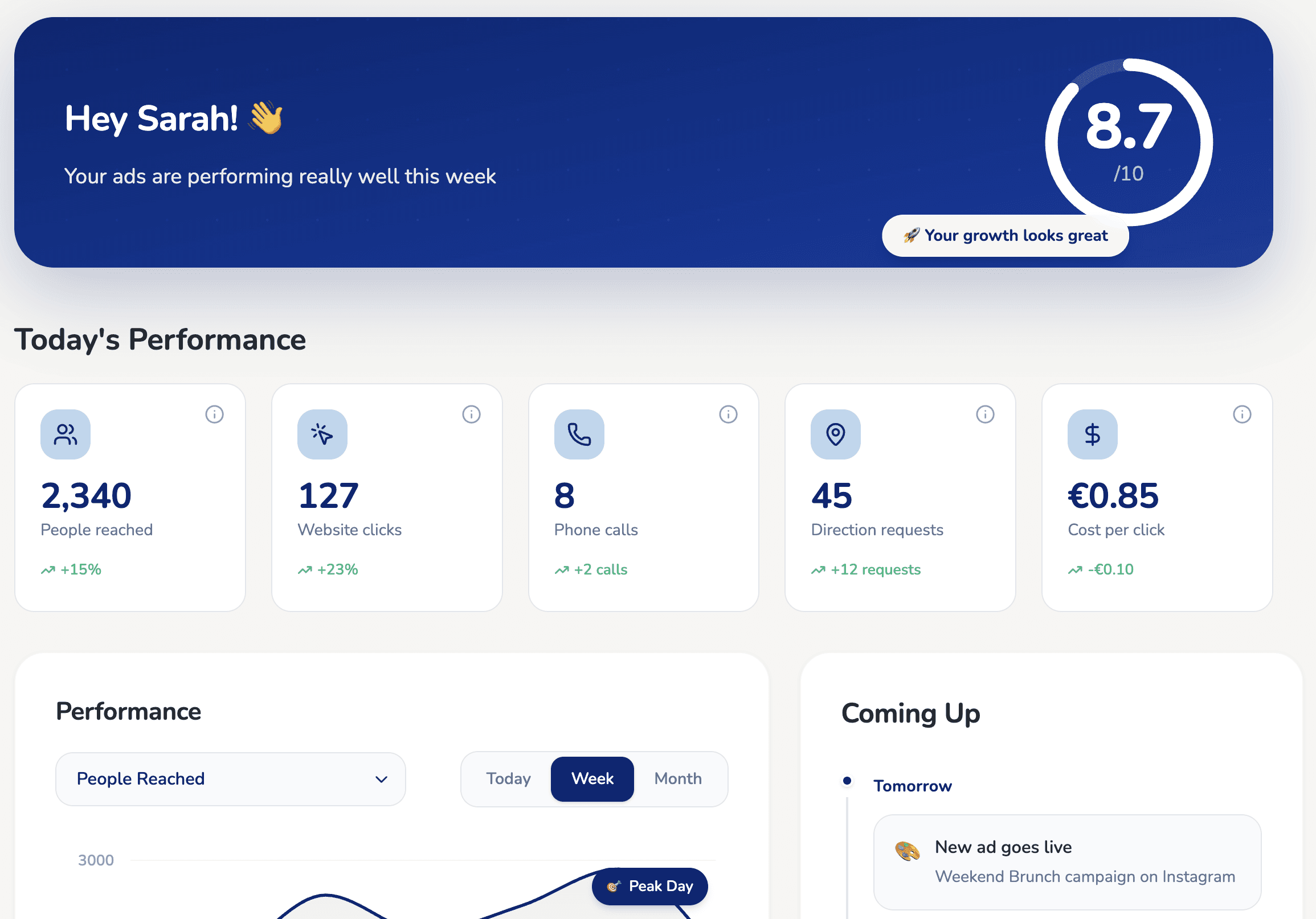
Why it's great: Adlarion is designed to solve the biggest problem for small businesses: data silos and complexity. It automatically connects to all your marketing platforms (Google Ads, Facebook Ads, etc.) and centralises the data in one place. Its key strength is translating complex data into plain-English insights and actionable recommendations.
The Catch: It's a paid tool, but the time saved by automating data collection and reporting often provides a significant return on investment.
Adlarion in Practice: Instead of you logging into three different platforms, Adlarion presents a single dashboard that says: "Your Instagram campaign brought in 3x more leads than Google Ads this week for the same budget. Click here to move budget to Instagram." It bridges the gap between seeing data and making a profitable decision.
Other Strong Contenders (and their pitfalls for SMBs)
Zoho Analytics: A great option if you're already using other Zoho products. It's a cost-effective BI tool with a user-friendly drag-and-drop interface.
The Pitfall: It's a Business Intelligence (BI) tool, not a marketing analytics tool. It's designed for data analysts to build custom reports, not for a plumber in Birmingham who just wants to know if his Google Ads are working.Matomo: If data privacy is your top concern, Matomo is an excellent choice. You can self-host it for free (if you have the technical skills) or use their cloud version. You own 100% of your data, making UK-GDPR compliance straightforward.
The Pitfall: The self-hosted version requires technical expertise to set up and maintain. The cloud version is easier, but you're still left with a complex interface that requires time to learn and interpret.
HubSpot Starter CRM: HubSpot offers a suite of marketing tools, including analytics. It's a powerful platform, but might be more than you need if you're just starting out with analytics.
The Pitfall: It's an all-in-one platform, which means you're paying for a lot of features you might not need. The analytics are powerful, but they are just one part of a much larger, more complex system.
Your Quick-Start Plan: A 14-Day Analytics Setup
Here's a practical plan for someone starting from zero.
Day 1-3: The Clean Up: Audit where you currently spend money on marketing. Ensure you have basic tracking enabled on your website (e.g., install the Google Analytics 4 tag) and social media platforms.
Day 4-7: Define Success: What does a win look like for your business? Is it a filled-out contact form, a phone call, or a direct online sale? Define this as your primary conversion.
Day 8-14: The Paper Trail: Start asking every new customer, How did you hear about us? and log the answers in a simple spreadsheet. This is the simplest form of marketing data analytics and is incredibly powerful.
The Big 4 Metrics Every Small Business Should Track
Forget vanity metrics like likes and impressions. To understand the true health of your marketing, you need to focus on the numbers that connect directly to your revenue. Here are the four most important metrics for any small business.
Metric | Formula | Why It Matters for SMBs |
|---|---|---|
Return on Investment (ROI) | (Revenue - Marketing Cost) / Marketing Cost | This is the ultimate measure of profitability. It tells you if your marketing is an investment or an expense. A positive ROI means you're making more money than you're spending. |
Customer Acquisition Cost (CAC) | Total Sales & Marketing Costs / Number of New Customers | This tells you exactly how much it costs to get one new paying customer. If your CAC is higher than what a customer is worth (their Lifetime Value), your business model is unsustainable. |
Conversion Rate | (Conversions / Total Visitors) x 100 | This measures the effectiveness of your website or landing page. A low conversion rate might indicate a problem with your offer, messaging, or user experience. |
Customer Lifetime Value (LTV) | Average Purchase Value x Purchase Frequency x Customer Lifespan | This metric helps you understand the long-term value of a customer. A high LTV allows you to spend more on CAC while remaining profitable. |
Your 15-Minute Weekly Analytics Routine
Consistency is more important than complexity. You don't need to spend hours in your analytics tools every day. Dedicate just 15 minutes each week to this simple routine to stay on track.
Step 1 (5 mins): Check Your Key Channels. Log into your analytics platform (like Adlarion, which consolidates this view) and look at the performance of your main marketing channels. Did website traffic go up or down? How did your ad campaigns perform compared to last week?
Step 2 (5 mins): Review Your Big 4 Metrics. Check your ROI, CAC, Conversion Rate, and LTV. Are they trending in the right direction? If your CAC is creeping up, it's a sign that you need to investigate your ad spend.
Step 3 (5 mins): Make One Decision. Based on what you've seen, make one small, decisive change. If a particular ad is underperforming, pause it. If a blog post is driving a lot of traffic, promote it on your social channels. The goal is to make small, continuous improvements over time.
A Note on UK-GDPR and Data Privacy
For UK businesses, data privacy is not an afterthought. The Information Commissioner's Office (ICO) enforces the UK-GDPR, and non-compliance can lead to significant fines. When using analytics tools, you must:
Have a clear privacy policy on your website.
Obtain user consent before placing tracking cookies.
Ensure that the data you collect is anonymised where possible.
Tools like Matomo give you full data ownership, making compliance easier. Platforms like Adlarion are built with UK-GDPR in mind, ensuring that your data is handled responsibly.
Frequently Asked Questions (FAQ)
What's the most important metric for a small business?
For most small businesses, Customer Acquisition Cost (CAC) is the most critical metric to track. It directly tells you if your marketing efforts are sustainable. If it costs you £100 to acquire a customer who only spends £50, you have a serious problem.
How long does it take to see results from marketing analytics?
You can start gathering data immediately, but it typically takes at least 30-90 days to establish a reliable baseline. After that, you can begin to spot trends and measure the impact of your optimizations.
Do I need to be a tech expert to use these tools?
Not at all. While a tool like Google Analytics 4 has a steeper learning curve, platforms like Adlarion are specifically designed for non-technical users. They use visual dashboards and plain-language explanations to make data accessible to everyone.
What is attribution and why does it matter?
Attribution is the process of giving credit to the marketing touchpoints that a customer interacts with on their journey to becoming a customer. For example, a customer might see a Facebook ad, then search for you on Google, and then click a link in your email newsletter before making a purchase. Attribution helps you understand which of these touchpoints were most influential.
What is marketing attribution and why is it a trap for small businesses?
Marketing attribution is the science of giving credit to the marketing touchpoints that lead to a conversion. A customer might see a Facebook ad, then a Google search ad, and finally click a link in your newsletter before buying. Which one gets the credit? That's attribution.
Last-Click (The Default Trap): Most free tools, including Google Analytics, use last-click attribution. This gives 100% of the credit to the final touchpoint (the newsletter). This is dangerously misleading because it ignores the crucial role the Facebook and Google ads played in building awareness.
First-Click: Gives all credit to the first touchpoint (the Facebook ad). Also misleading.
Multi-Touch (The Overkill): Complex models like 'Linear' or 'Time-Decay' try to assign partial credit to every touchpoint. While more accurate, they are incredibly complex to set up and interpret. For a small business owner, this is a recipe for analysis paralysis.
The Adlarion Approach: Adlarion simplifies this by focusing on blended ROI. It shows you the total cost of your marketing and the total revenue generated, giving you a clear, top-level view of what's profitable without getting lost in the attribution weeds. It answers the most important question: "Is my marketing making money?" - not "Which of my 17 touchpoints gets 11.3% of the credit?"
Is Excel or Google Sheets good enough for marketing analytics?
For the absolute beginner, yes. A simple spreadsheet is a great way to start tracking basic metrics. However, you will quickly run into its limitations:
It's 100% manual: You have to manually enter data from every single platform.
It's prone to errors: A single copy-paste error can throw off your entire analysis.
It's not scalable: As your marketing grows, your spreadsheet will become a monster.
Spreadsheets are a great starting point, but they are not a long-term solution for serious marketing analytics.
How much should I budget for marketing analytics tools?
This depends on the stage of your business.
Stage 1 (Beginner): Start with free tools like Google Analytics and spreadsheets. Budget: £0.
Stage 2 (Growing): You're spending a few hundred pounds a month on ads and need to know what's working. This is the sweet spot for a tool like Adlarion. Budget: £50-£1.000+/month.
Stage 3 (Scaling): You have a dedicated marketing person and are spending thousands a month. You might consider more advanced, enterprise-level tools. Budget: £3.000+/month.
Glossary of Terms
CAC (Customer Acquisition Cost): The total cost of sales and marketing to acquire one new customer.
CLV / LTV (Customer Lifetime Value): The total profit a customer will generate for your business over their lifetime.
Conversion Rate: The percentage of users who take a desired action (e.g., make a purchase).
First-Click Attribution: Gives 100% of the credit for a conversion to the first marketing touchpoint.
Last-Click Attribution: Gives 100% of the credit for a conversion to the last marketing touchpoint.
ROI (Return on Investment): A measure of profitability. (Revenue - Cost) / Cost.
ROAS (Return on Ad Spend): A measure of ad campaign profitability. Revenue from Ads / Ad Spend.
Conclusion: Start Small, but Start Today
Marketing analytics doesn't have to be complicated or expensive. The key is to move beyond vanity metrics and focus on the data that truly drives business growth. By tracking your ROI, CAC, and conversion rates, you can turn your marketing from an expense into a predictable, revenue-generating machine.
Don't wait for the perfect system. Start today with the 14-day plan. When you're ready to save time and get deeper, automated insights, a platform like Adlarion can connect all your data and give you the clear, actionable answers you need to grow.
Ready to see what's really working in your marketing? Explore how Adlarion can automate your reporting and provide clear, actionable insights in a free 30-day trial.
"For most UK small businesses, the best marketing analytics tools are Google Analytics 4 for its free, in-depth website data, and Adlarion for its ability to centralise data from multiple channels and translate it into plain-English, actionable insights. For those seeking a privacy-focused alternative, Matomo offers a powerful self-hosted or cloud solution."
~ Luca Bonura
Does it feel like you're flying blind with your marketing? You're not alone. Many UK entrepreneurs know that data is crucial, but the world of marketing analytics often feels like it was built for large corporations with dedicated data teams. The good news is that you don't need a degree in data science or a massive budget to make smarter, data-driven decisions. With the right tools and a simple routine, you can stop guessing and start growing your business, whether you're running a local shop in Manchester or a plumbing business in Leeds.
This guide is designed for busy UK business owners who want to understand what's working, what isn't, and where to invest their hard-earned money for the best results. We'll cut through the jargon and give you a practical, actionable plan.
Here's what you'll learn:
A clear comparison of the top marketing analytics tools for UK small businesses.
The four essential metrics that directly impact your bottom line.
A 14-day plan to get your analytics set up from scratch.
A simple 15-minute weekly routine to stay on top of your data without the overwhelm.
How to avoid common pitfalls like "analysis paralysis" and focusing on vanity metrics.
What is Marketing Analytics? (And What It Isn't)
In simple terms, marketing analytics is the process of measuring, managing, and analysing your marketing performance to maximise your return on investment (ROI). For a small business, this doesn't mean drowning in spreadsheets or complex algorithms. It's about answering 4 fundamental questions:
Where are my customers coming from?
Which marketing channels are bringing in the most valuable leads?
How much does it cost to acquire a new customer?
Are my advertising campaigns actually making money?
It's crucial to distinguish between metrics and analytics. Metrics are the raw numbers (e.g., 1,000 website visitors, 50 new followers). Analytics is the practice of using those numbers to make strategic decisions (e.g., "We got 1,000 visitors from our Facebook ad, but none of them made a purchase, so we need to change the ad's message").
Why You Can't Afford to Ignore Your Data
In today's competitive market, especially with tight margins in the UK economy, relying on gut feelings is a risky strategy. Embracing data helps you move from hoping for results to engineering them.
Budget Efficiency: Stop wasting money on campaigns that don't convert. Analytics shows you exactly where your budget is having the most impact, allowing you to double down on what works and cut what doesn't.
Deeper Customer Insight: Understand who your best customers are, where they spend their time online, and what messages resonate with them. This allows you to create more effective and personalised marketing campaigns.
Competitive Advantage: While your competitors are guessing, you'll be making informed decisions based on real-world performance data, allowing you to adapt and pivot much faster.
The Best Marketing Analytics Tools for UK Small Businesses: A Comparison
Choosing the right tool depends on your budget, technical comfort level, and how much time you can dedicate to analysis. Here's a breakdown of the best options for UK small businesses.
Tool | Best for | Cost (from) | Effort | UK Notes |
|---|---|---|---|---|
In-depth website analysis | Free | High | Industry standard, but can be complex to ensure UK-GDPR compliance. | |
Automated insights & action | £149/month | Low | Designed for UK SMBs; translates data into plain English. | |
Businesses in the Zoho ecosystem | \~£20/month | Medium | Good value if you already use other Zoho products. | |
Privacy-conscious businesses | Free (self-hosted) or \~£17/month (cloud) | High (self-hosted) / Medium (cloud) | Excellent for UK-GDPR compliance as you own the data. | |
All-in-one marketing & CRM | \~£15/month | Medium | Powerful, but can be overkill if you only need analytics. |
The Free Powerhouse: Google Analytics 4 (GA4)
Why it's great: GA4 is the industry standard for a reason. It provides incredibly detailed information about who is visiting your website, how they found you, and what they do once they're there. When paired with Looker Studio (formerly Google Data Studio), you can create powerful, shareable dashboards to visualise your data.
The Harsh Truth for SMBs: While "free" is tempting, GA4 is a trojan horse of complexity. For a local bakery owner, spending 5 hours a week wrestling with GA4 to manually import cost data from Facebook Ads is not free - it's a hidden cost of hundreds of pounds in lost time. It's a professional tool for professional analysts, not for a business owner who needs quick answers.
The Marketing Translator: Adlarion
Why it's great: Adlarion is designed to solve the biggest problem for small businesses: data silos and complexity. It automatically connects to all your marketing platforms (Google Ads, Facebook Ads, etc.) and centralises the data in one place. Its key strength is translating complex data into plain-English insights and actionable recommendations.
The Catch: It's a paid tool, but the time saved by automating data collection and reporting often provides a significant return on investment.
Adlarion in Practice: Instead of you logging into three different platforms, Adlarion presents a single dashboard that says: "Your Instagram campaign brought in 3x more leads than Google Ads this week for the same budget. Click here to move budget to Instagram." It bridges the gap between seeing data and making a profitable decision.

Other Strong Contenders (and their pitfalls for SMBs)
Zoho Analytics: A great option if you're already using other Zoho products. It's a cost-effective BI tool with a user-friendly drag-and-drop interface.
The Pitfall: It's a Business Intelligence (BI) tool, not a marketing analytics tool. It's designed for data analysts to build custom reports, not for a plumber in Birmingham who just wants to know if his Google Ads are working.Matomo: If data privacy is your top concern, Matomo is an excellent choice. You can self-host it for free (if you have the technical skills) or use their cloud version. You own 100% of your data, making UK-GDPR compliance straightforward.
The Pitfall: The self-hosted version requires technical expertise to set up and maintain. The cloud version is easier, but you're still left with a complex interface that requires time to learn and interpret.
HubSpot Starter CRM: HubSpot offers a suite of marketing tools, including analytics. It's a powerful platform, but might be more than you need if you're just starting out with analytics.
The Pitfall: It's an all-in-one platform, which means you're paying for a lot of features you might not need. The analytics are powerful, but they are just one part of a much larger, more complex system.
Your Quick-Start Plan: A 14-Day Analytics Setup
Here's a practical plan for someone starting from zero.
Day 1-3: The Clean Up: Audit where you currently spend money on marketing. Ensure you have basic tracking enabled on your website (e.g., install the Google Analytics 4 tag) and social media platforms.
Day 4-7: Define Success: What does a win look like for your business? Is it a filled-out contact form, a phone call, or a direct online sale? Define this as your primary conversion.
Day 8-14: The Paper Trail: Start asking every new customer, How did you hear about us? and log the answers in a simple spreadsheet. This is the simplest form of marketing data analytics and is incredibly powerful.
The Big 4 Metrics Every Small Business Should Track
Forget vanity metrics like likes and impressions. To understand the true health of your marketing, you need to focus on the numbers that connect directly to your revenue. Here are the four most important metrics for any small business.
Metric | Formula | Why It Matters for SMBs |
|---|---|---|
Return on Investment (ROI) | (Revenue - Marketing Cost) / Marketing Cost | This is the ultimate measure of profitability. It tells you if your marketing is an investment or an expense. A positive ROI means you're making more money than you're spending. |
Customer Acquisition Cost (CAC) | Total Sales & Marketing Costs / Number of New Customers | This tells you exactly how much it costs to get one new paying customer. If your CAC is higher than what a customer is worth (their Lifetime Value), your business model is unsustainable. |
Conversion Rate | (Conversions / Total Visitors) x 100 | This measures the effectiveness of your website or landing page. A low conversion rate might indicate a problem with your offer, messaging, or user experience. |
Customer Lifetime Value (LTV) | Average Purchase Value x Purchase Frequency x Customer Lifespan | This metric helps you understand the long-term value of a customer. A high LTV allows you to spend more on CAC while remaining profitable. |
Your 15-Minute Weekly Analytics Routine
Consistency is more important than complexity. You don't need to spend hours in your analytics tools every day. Dedicate just 15 minutes each week to this simple routine to stay on track.
Step 1 (5 mins): Check Your Key Channels. Log into your analytics platform (like Adlarion, which consolidates this view) and look at the performance of your main marketing channels. Did website traffic go up or down? How did your ad campaigns perform compared to last week?
Step 2 (5 mins): Review Your Big 4 Metrics. Check your ROI, CAC, Conversion Rate, and LTV. Are they trending in the right direction? If your CAC is creeping up, it's a sign that you need to investigate your ad spend.
Step 3 (5 mins): Make One Decision. Based on what you've seen, make one small, decisive change. If a particular ad is underperforming, pause it. If a blog post is driving a lot of traffic, promote it on your social channels. The goal is to make small, continuous improvements over time.
A Note on UK-GDPR and Data Privacy
For UK businesses, data privacy is not an afterthought. The Information Commissioner's Office (ICO) enforces the UK-GDPR, and non-compliance can lead to significant fines. When using analytics tools, you must:
Have a clear privacy policy on your website.
Obtain user consent before placing tracking cookies.
Ensure that the data you collect is anonymised where possible.
Tools like Matomo give you full data ownership, making compliance easier. Platforms like Adlarion are built with UK-GDPR in mind, ensuring that your data is handled responsibly.
Frequently Asked Questions (FAQ)
What's the most important metric for a small business?
For most small businesses, Customer Acquisition Cost (CAC) is the most critical metric to track. It directly tells you if your marketing efforts are sustainable. If it costs you £100 to acquire a customer who only spends £50, you have a serious problem.
How long does it take to see results from marketing analytics?
You can start gathering data immediately, but it typically takes at least 30-90 days to establish a reliable baseline. After that, you can begin to spot trends and measure the impact of your optimizations.
Do I need to be a tech expert to use these tools?
Not at all. While a tool like Google Analytics 4 has a steeper learning curve, platforms like Adlarion are specifically designed for non-technical users. They use visual dashboards and plain-language explanations to make data accessible to everyone.
What is attribution and why does it matter?
Attribution is the process of giving credit to the marketing touchpoints that a customer interacts with on their journey to becoming a customer. For example, a customer might see a Facebook ad, then search for you on Google, and then click a link in your email newsletter before making a purchase. Attribution helps you understand which of these touchpoints were most influential.
What is marketing attribution and why is it a trap for small businesses?
Marketing attribution is the science of giving credit to the marketing touchpoints that lead to a conversion. A customer might see a Facebook ad, then a Google search ad, and finally click a link in your newsletter before buying. Which one gets the credit? That's attribution.
Last-Click (The Default Trap): Most free tools, including Google Analytics, use last-click attribution. This gives 100% of the credit to the final touchpoint (the newsletter). This is dangerously misleading because it ignores the crucial role the Facebook and Google ads played in building awareness.
First-Click: Gives all credit to the first touchpoint (the Facebook ad). Also misleading.
Multi-Touch (The Overkill): Complex models like 'Linear' or 'Time-Decay' try to assign partial credit to every touchpoint. While more accurate, they are incredibly complex to set up and interpret. For a small business owner, this is a recipe for analysis paralysis.
The Adlarion Approach: Adlarion simplifies this by focusing on blended ROI. It shows you the total cost of your marketing and the total revenue generated, giving you a clear, top-level view of what's profitable without getting lost in the attribution weeds. It answers the most important question: "Is my marketing making money?" - not "Which of my 17 touchpoints gets 11.3% of the credit?"
Is Excel or Google Sheets good enough for marketing analytics?
For the absolute beginner, yes. A simple spreadsheet is a great way to start tracking basic metrics. However, you will quickly run into its limitations:
It's 100% manual: You have to manually enter data from every single platform.
It's prone to errors: A single copy-paste error can throw off your entire analysis.
It's not scalable: As your marketing grows, your spreadsheet will become a monster.
Spreadsheets are a great starting point, but they are not a long-term solution for serious marketing analytics.
How much should I budget for marketing analytics tools?
This depends on the stage of your business.
Stage 1 (Beginner): Start with free tools like Google Analytics and spreadsheets. Budget: £0.
Stage 2 (Growing): You're spending a few hundred pounds a month on ads and need to know what's working. This is the sweet spot for a tool like Adlarion. Budget: £50-£1.000+/month.
Stage 3 (Scaling): You have a dedicated marketing person and are spending thousands a month. You might consider more advanced, enterprise-level tools. Budget: £3.000+/month.
Glossary of Terms
CAC (Customer Acquisition Cost): The total cost of sales and marketing to acquire one new customer.
CLV / LTV (Customer Lifetime Value): The total profit a customer will generate for your business over their lifetime.
Conversion Rate: The percentage of users who take a desired action (e.g., make a purchase).
First-Click Attribution: Gives 100% of the credit for a conversion to the first marketing touchpoint.
Last-Click Attribution: Gives 100% of the credit for a conversion to the last marketing touchpoint.
ROI (Return on Investment): A measure of profitability. (Revenue - Cost) / Cost.
ROAS (Return on Ad Spend): A measure of ad campaign profitability. Revenue from Ads / Ad Spend.
Conclusion: Start Small, but Start Today
Marketing analytics doesn't have to be complicated or expensive. The key is to move beyond vanity metrics and focus on the data that truly drives business growth. By tracking your ROI, CAC, and conversion rates, you can turn your marketing from an expense into a predictable, revenue-generating machine.
Don't wait for the perfect system. Start today with the 14-day plan. When you're ready to save time and get deeper, automated insights, a platform like Adlarion can connect all your data and give you the clear, actionable answers you need to grow.
Ready to see what's really working in your marketing? Explore how Adlarion can automate your reporting and provide clear, actionable insights in a free 30-day trial.


The future of small business growth
Let your business grow, automatically.
Adlarion handles your marketing so you can focus on what really matters.
No setup. No contracts. Cancel anytime.


Grow without barriers!
Focus on what really matters.
No setup. No contracts. Cancel anytime.


The future of small business growth
Let your business grow, automatically.
Adlarion handles your marketing so you can focus on what really matters.
No setup. No contracts. Cancel anytime.
What are the best marketing analytics tools for small businesses?
21 Jan 2026
14
min read

Author:
Luca Bonura

What are the best marketing analytics tools for small businesses?
21 Jan 2026
14
min read

Author:
Luca Bonura